I’m just back from Paris where I must go from time to time for treatment of my APDS, a chronic condition that can only be treated in that place. (APDS = Acute Paris Deprivation Syndrome)
Before I retired and became a full-time layabout, I was a Structural Engineer and this is why the Notre Dame de Paris has always fascinated me. In my working life, my professional mandate was to look at a structure or a proposed structure and see the invisible push and pull of forces acting upon it, make it conform to building codes, make it practical and economical to construct, and make it to not fall down which would cause much embarrassment and loss of life.
The picture below shows the back end of the Cathedral and its flying buttresses. The roof structure consisted of wood trusses overlain with wood planking and lead shingles, all very heavy. Under that roof structure are the stone vaults that you see as a ceiling from inside the church. These loads would impose upon the walls as a vertical force and a lateral thrust that would destroy the walls by pushing them outwards. The lateral component of force is resisted by the flying buttresses.
Look at those flying buttresses, how long and slender they are; it appears they must be made of steel or reinforced concrete. But no, they are just stones pushing against each other, held in place by friction and that lateral pressure from the roof. You might think they are held in place by mortar, but no, if there is mortar it only holds them apart. At nine hundred years old, that mortar probably wouldn’t do much of anything. So, what might happen if half of that lateral force is removed by burning the roof? A house-of-cards model may be applicable.
The roof was removed by the fire, the spire collapsed, one of the stone vaults fell to the floor, but the buttresses held and the sequence of failure stopped there. The buttresses have been given new support by installing wooden trusses, just as they were supported nine centuries ago during construction. You can see the trusses in the picture. Earliest stages of the restoration were performed by workers dangling on ropes from the tower crane. Now the whole thing is wrapped in scaffolding and work stages and it’s more secure.
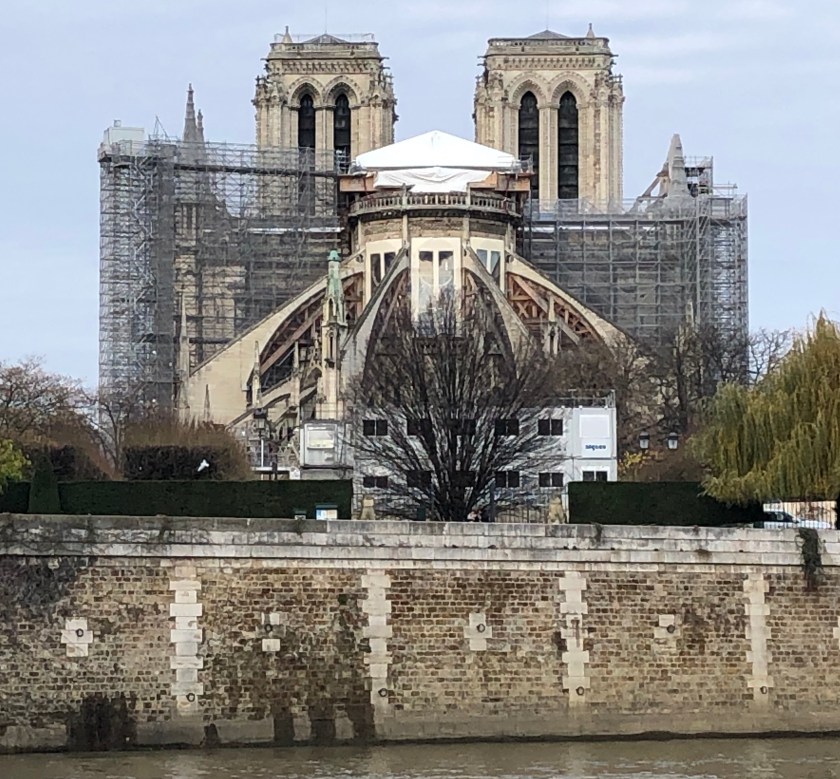
One of the two towers was on fire too, the one on the right in the above picture. You might think this tower of stone can’t burn, but you would be wrong. The supporting structure is made of oak posts and beams; the stone serves only as exterior cladding. It looks like an old Ontario barn, though much bigger. I’ve been there. The biggest bell “Le Bourdon” weighs thirteen tonnes. Firefighters had to drag their hoses inside to access the flames, not knowing if the whole thing was going to come down on their heads.

The builders of this magnificent thing nine hundred years ago had no computers, no tower crane, no power tools, not even a tape measure. They preceded by several centuries Isaac Newton’s laws on action and reaction which are the basis of structural analysis, Leibnitz’ discovery of the calculus and Napier’s discovery of Logarithms. They were winging it with only their intuition and hands-on experience from other projects.
 Tales of a layabout